
Documents With Dates: The Compliance File That Moves a Vegan Launch
Launches are delayed by documents far more often than by production, and the reason is almost always timing rather than content. A material statement that arrives after artwork is printed is worth very little, even if it is perfect. Treat each document as an item with a date attached, work out which stage it blocks, and the compliance file stops being an end-of-project chore and becomes part of the critical path you can actually manage.
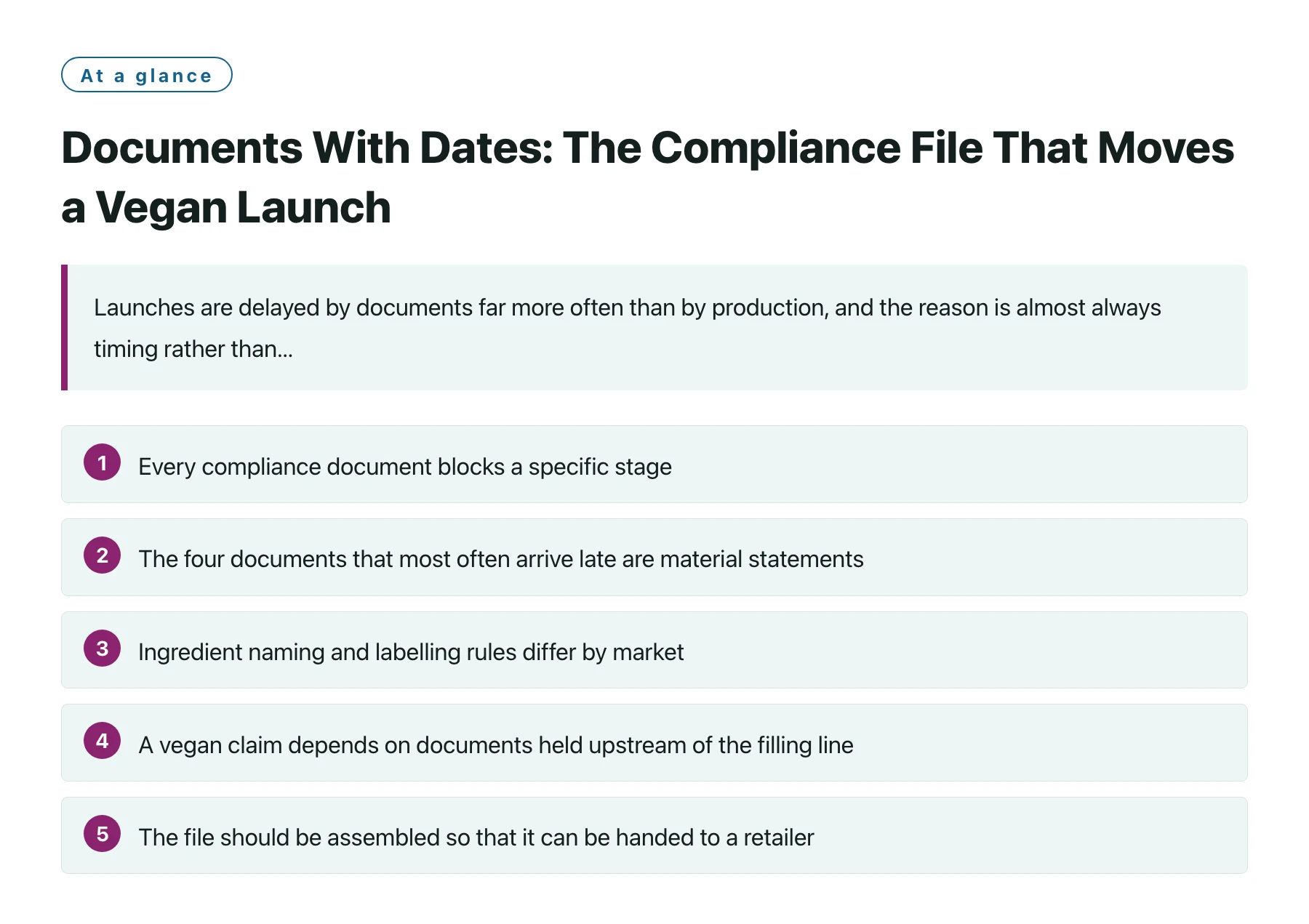
Key takeawaysEvery compliance document blocks a specific stage, so the useful question is not whether it exists but when it has to exist. · The four documents that most often arrive late are material statements, allergen information, label artwork approval and stability records. · Ingredient naming and labelling rules differ by market, so the file should be organised by destination rather than as one undifferentiated folder. · A vegan claim depends on documents held upstream of the filling line, which means the collection work has to start before the formula is frozen. · The file should be assembled so that it can be handed to a retailer, a marketplace or a regulator without anyone having to reconstruct it.
A small brand once missed a shipping window by eleven days because a statement about an adhesive had never been requested. The fragrance was approved, the bottles were decorated, the cartons were printed, and the only missing item was a piece of paper about a component nobody had thought of as part of the claim. That is the normal shape of a documentation delay: not a regulatory refusal, but an unrequested document discovered late.
The fix is not to collect more paperwork. It is to decide, before the project starts, which document blocks which stage, and then to collect against those dates. A file assembled that way is smaller than most brands expect and considerably more useful.
This is a scheduling view of fragrance compliance written for a vegan-positioned launch, with the documents listed in the order the calendar needs them rather than in the order a folder usually holds them.
A document is a date, not a folder
The instinct to build a compliance folder at the end of a project is understandable and it is also the reason documentation causes delays. By the end, every stage that could have used the document has already passed, so any gap becomes a rework rather than a correction. Moving the collection forward does not add work; it moves work to a point where it is cheaper.
The way to do that is to work backwards from printing. Artwork cannot be finalised until the label content is settled. Label content cannot be settled until the ingredient description and allergen information are known. Allergen information depends on the formula. A material statement that arrives after the formula is frozen can still invalidate the label, which means the whole chain reopens.
This is why a document should be recorded with two dates: the date you requested it and the date it has to exist. Any document whose second date falls after printing has effectively been requested too late, no matter how early the request was sent.
Organise by destination, not by type
Labelling and ingredient expectations differ between markets, and the differences are the practical part of compliance work. The European Commission, for example, maintains a set of pages on specific cosmetic product topics that includes areas such as allergens and animal testing, which is a useful orientation for what a European label has to address [1]. A file organised by destination market makes those differences visible instead of hiding them in a single pile of certificates.
Seven documents and the stage each one blocks
| Document | Who issues it | When it has to exist |
|---|---|---|
| Formula specification | The developing factory | Before the first sample is evaluated, so feedback is against a fixed reference |
| Material statements for the vegan claim | Raw material suppliers, collected by the factory | Before the formula is formally frozen, because a change invalidates the set |
| Allergen information for labelling | The factory, based on the formula and the applicable rules | Before label content is settled |
| Safety and stability records | The factory's laboratory or an external laboratory | Before bulk production is released, and ideally before artwork is printed |
| Component declarations for adhesives, inks and coatings | Packaging and decoration suppliers | Before the claim wording is finalised on the carton |
| Label artwork approval | Brand and factory jointly, per market | Before printing, with time for one correction round |
| Batch record and certificate of analysis | The producing factory | At release, and it should reference the approved reference sample |
Read the table from the top down. Each row depends on the rows above it, which is why collecting them one at a time at the end cannot work.
The documents that actually arrive late
In practice, four items cause most of the delay. Material statements are first, because they depend on suppliers who are not part of the project and have no reason to prioritise a request. Component declarations for adhesives and inks are second, because they belong to packaging rather than to fragrance and often fall between two suppliers. Allergen information is third, because it cannot be finalised while the formula is still moving. Stability records are fourth, because they take a fixed amount of time that cannot be compressed by asking nicely.
The first two can be solved by requesting them early, before the project feels urgent. The second two can only be planned around, which means they belong in the schedule as fixed durations rather than as tasks someone hopes to finish quickly.
Market-specific rules add a further layer. Health Canada, for example, publishes guidance on cosmetic safety for products sold in Canada, and the requirements are not identical to European ones [2]. A brand selling into several markets should expect to maintain more than one label variant, and should budget the review time accordingly rather than assuming one label serves everywhere.
Who issues the file also matters, and it is worth settling before the order. A factory that can produce documents in your brand's name, and keep them current, is a different counterparty from one that forwards whatever it happens to hold, which is why fragrance OEM/ODM production partner selection should include the documentation question rather than leaving it to the project.
Safe-use standards belong in the brief
Fragrance materials are assessed for safe use under standards maintained by the International Fragrance Association, which publishes material explaining how fragrance science and safe-use evaluation work [3]. For a vegan-positioned line this matters at the point of substitution: the replacement material has its own assessment and its own limits, and those limits belong in the brief rather than in a post-approval review.
Keeping the file handover-ready
A compliance file earns its keep when someone else has to use it. A retailer onboarding the product, a marketplace asking for evidence of a claim, or a distributor in a second market will all ask for the same few items. If those items are stored with the batch record and named consistently, the answer takes an hour. If they are scattered across email threads, the answer takes a week and the claim looks weaker than it is.
Name files by product, market and document type, and keep one index that says what exists and what is still outstanding. The index is more valuable than the folder, because it makes gaps visible while there is still time to close them.
One document is worth requesting separately because it validates the rest: the report showing the product was tested against its specification. safety testing in perfume manufacturing is the stage that converts a set of declarations into a measured result, and it is also the item a serious buyer will ask for first.
Why the file is a partnership question
For a brand running several products through the same factory, the file also becomes an asset rather than an overhead, because it is the record that makes a second order faster than the first. Every document already on file is one fewer collection round on the next launch.
Taken together, the file is not bureaucracy. It is the evidence that supports every claim on the carton, including the vegan one, and the schedule is what makes it available in time. A manufacturer that explains how it assembles that evidence, as Xuelei Fragrances does in describing its development and production process, is easier to plan with than one that treats documents as an afterthought.
Give every document a blocking stage and a deadline in the project plan. A document with no deadline attached is the one that will be missing when the printer is ready.
Sources
- European Commission: Cosmetic Products — Specific Topics —— EU pages covering specific cosmetics topics such as product claims, nanomaterials and animal-testing rules.
- Health Canada: Cosmetic Safety —— Health Canada's cosmetics pages, covering cosmetic notification, the ingredient hotlist and safety requirements for cosmetics sold in Canada.
- IFRA: Safe Use and Fragrance Science —— IFRA's explanation of how fragrance materials are scientifically assessed for safe use and how those conclusions are applied by the industry.
Frequently asked questions
What documents does a vegan perfume launch need?
At minimum: formula specification, material statements covering the claim, allergen information, stability and safety records, component declarations for adhesives and inks, approved label artwork per market, and batch records with a certificate of analysis.
When should I request documentation from a fragrance factory?
Before the formula is frozen for material statements, and before label content is settled for allergen information. Requesting everything after approval usually turns documentation into a rework stage.
Can one label serve several markets?
Sometimes, but not by assumption. Labelling and ingredient expectations differ between jurisdictions, so the label should be reviewed per destination market and the review time budgeted.
Who owns the vegan documentation, the brand or the factory?
It depends on the statements involved. Factories usually hold production records and can issue documents in the brand's name, while material statements originate with raw material suppliers and are passed through.
How do I check that the file is complete?
Keep an index that lists each document, its blocking stage and its status. The index makes gaps visible early, which is the only point at which they are cheap to fix.