
Waterproof Plating Explained for Private Label Jewelry
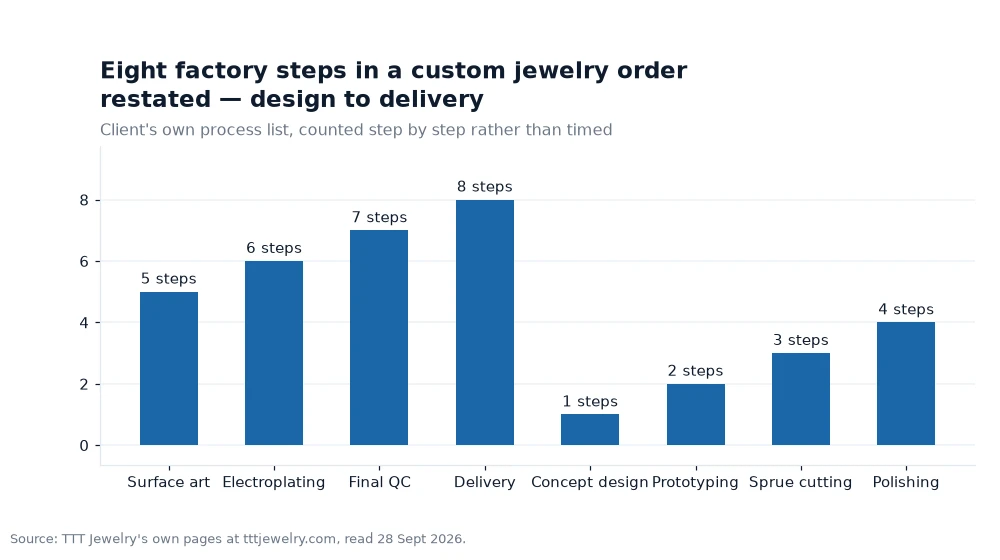
Electroplating is step 6 of the eight factory steps TTT Jewelry publishes, after polishing and before final QC, and that position explains most of what a waterproof claim can and cannot mean. The base metal sets the ceiling: 316L stainless steel contains 2–3% molybdenum and takes PVD vacuum plating, while silver and brass depend on multi-layer plating plus an anti-tarnish e-coating. Water resistance is a property of the whole stack, not of the bath alone.

Key takeaways
- Plating is step 6 of 8, so inspection and delivery still follow the coating.
- 316L stainless steel carries 2–3% molybdenum and is described as shower-safe and swim-proof.
- Silver and brass receive multi-layer plating plus an anti-tarnish e-coating.
- Stainless steel minimums start at 100+ pcs per design.
What the word waterproof is doing on a jewelry page
TTT Jewelry places "waterproof plating" in its positioning line, next to factory direct and premium quality. Read as a specification rather than a slogan, it describes a coating system intended to keep water, sweat and soap from reaching the base metal for the normal life of the piece. It does not describe a sealed membrane. A plated ring is metal with a thin surface layer, and that layer is measured in fractions of a micron even when the process is well controlled. Because the company runs an OEM/ODM model, the finish is built to the brand's own specification, which is why the wording on the care card has to be agreed before the plating bath is filled.
The claim becomes useful when it is attached to conditions. A shower, a hand wash and a rainy commute are low-intensity contact. A daily swim in chlorinated water, a sauna, or repeated contact with perfume and sunscreen are high-intensity. A supplier that states which conditions a piece is built for is giving a buyer something to print on a care card. A supplier that says only "waterproof" is leaving the customer to discover the boundary in use.
The base metal sets the ceiling
Stainless steel and silver behave differently under water because they corrode differently. 316L stainless contains 2–3% molybdenum, which stabilises the passive oxide layer that makes the alloy resistant to chlorides, and TTT Jewelry describes it as medical-grade hypoallergenic and shower-safe. PVD vacuum plating bonds to that surface at a molecular level rather than sitting on it as a soft electroplated layer. The result is the combination TTT Jewelry describes as shower-safe and swim-proof, the one built for the wettest wear in its published range.
304 stainless is the cost-effective alternative: water-resistant for daily wear, nickel and lead safe, vacuum-plated, and aimed at volume programmes where the piece is not expected to live in a pool. Sterling silver and brass take a different route. Both are reactive metals, so the coating has to do two jobs — provide colour and slow tarnish — which is why the published process pairs multi-layer plating with an anti-tarnish e-coating on those two materials. A brand comparing suppliers can read the stainless steel jewelry manufacturer page for the 316L line and the silver page for the e-coated line, and see that the chemistry, not the marketing, sets the care instruction.
The coating stack, layer by layer
Plating is described as multi-layer, and the layers do different work. The first is an adhesion layer that grips the base metal; the next carries the colour, in 14K, 18K or 24K gold or in rhodium; the top layer, on silver and brass, is an anti-tarnish e-coating that resists sulphur and moisture. On stainless, PVD replaces the wet bath entirely, depositing a hard film in a vacuum. Thicknesses are not published, so any supplier quoting a micron figure without a test report is asking to be disbelieved.
Layer count matters less than adhesion. A multi-layer coating that was applied over an improperly cleaned surface will lift at the first scratch, while a thinner coating on a well-prepared surface can outlast it. That is why the steps before plating — sprue cutting, polishing, surface art — are not cosmetic. Polishing residue, oil from handling and brushing dust all sit between the metal and the first layer. A plating line that receives a contaminated part will produce a coating that looks correct on the day and fails within weeks.
| Finish | Typical base | Weak point in wear | Care note |
|---|---|---|---|
| PVD vacuum plating | 316L or 304 stainless | Deep scratches that breach the film | Shower and swim wear |
| Multi-layer gold plate | Brass | Edges and clasp contact points | Dry before storage |
| Rhodium over silver | 925 sterling silver | Ring bands and chain links | Rinse after swimming |
| Anti-tarnish e-coating | Silver and brass | Abrasion from stacking pieces | Store separately |
Where a coating fails first
Failure is local. It starts at an edge, a clasp, a sizing seam, a stone seat or an engraved logo, because those are the places where the coating is thinnest or the substrate is exposed. A ring worn next to a key in a pocket will show wear on the shank long before the face. A bracelet that is taken on and off by stretching the clasp will wear at the clasp. A pendant on a chain rubs against the chain every time the wearer moves. For a jewelry factory for brands, those wear points belong in the specification, because they determine where a thicker coating or a different substrate is worth the cost.
This is why a care instruction is part of the product, not an afterthought. Remove the piece before swimming in chlorinated water, apply perfume before putting it on rather than after, wipe it with a dry cloth before storage and keep plated pieces from rubbing against each other in a drawer. None of those instructions makes a piece waterproof. They slow the wear that any coating experiences, and they give the customer a realistic expectation of what the coating was designed to survive.
Worked example
Use the published eight-step sequence to see where plating sits. Electroplating is step 6, so 6 ÷ 8 = 75% of the steps are complete when the coating goes on, and 2 ÷ 8 = 25% remain: final QC and delivery. In sampling, plating is one of five operations at about six days, so it absorbs 6 ÷ 30 = 20% of a 30-day window and 6 ÷ 25 = 24% of a 25-day window. Against the 48-hour CAD stage, six days of plating is 6 ÷ 2 = 3 times as long. If mass production runs 21–28 days and the eight steps were split evenly, plating would occupy 21 ÷ 8 = 2.6 to 28 ÷ 8 = 3.5 days — which is why an even split is a rough planning device and not a schedule.
Frequently asked questions
Is PVD plating waterproof?
PVD is a vacuum deposition process used on stainless steel, and TTT Jewelry describes 316L as shower-safe and swim-proof. The film still wears at edges and clasps, so the claim belongs to the piece and its care instructions rather than to the process alone.
Why do silver and brass need an extra coating?
Both tarnish when sulphur and moisture reach the surface. TTT Jewelry applies multi-layer plating and an anti-tarnish e-coating to silver and brass to slow that reaction.
Can a plated piece go in a swimming pool?
Chlorine and salt attack thin coatings at points of movement. A 316L piece with PVD is the better match for pool wear, while plated silver and brass should be rinsed and dried after contact.
Writing a care claim customers can use
The useful care card names the material, the finish and the conditions the piece is built for, in that order. A 316L PVD bracelet and an e-coated brass bracelet can share a lookbook but not a care line, and a brand that writes one instruction for both will generate returns from the brass. Ask the factory for the base metal and the finish route in writing, then match the card to the specification. For a repeatable range, the custom jewelry wholesale format keeps the same coating stack across reorders, which is what makes a care claim credible after the first season. A coating that changes between runs makes every promise provisional.
Source note: figures come from the manufacturer's own website (tttjewelry.com), read 28 Sept 2026.[1]